Publication Day for my book, Teach a Kid to Save, is less than six weeks away. Maybe you’ve already pre-ordered your copy, thus helping ensure a big Day One. But did you know that TAKS is being offered in a free book giveaway on Goodreads? There are 15 copies available, so the odds of winning are steep, but give it a try, Goodreaders!
Last summer I found myself on an Amtrak train late at night, putting the finishing touches on a Paper Robots post about motivation. I so badly wanted to sleep, but I still needed to record the audio.1 Many people in the train car were asleep. So I did the logical thing: I went into the train’s bathroom to record there.
Now, it’s not uncommon to hear people murmuring strange utterances from behind the bathroom door of an Amtrak as it labors down the track, but I still think the people in the cabin could hear me and were weirded out.
When I emerged, I listened to the audio on my headphones, and it sounded like…I was recording in the bathroom of a speeding Amtrak train. So I re-recorded in the cold hours of the morning when I arrived home then collapsed into bed.
That is the content that I am re-posting today. I’ve always liked my Paper Robots series on motivation,2 and it formed an early part of Teach a Kid to Save. In fact, here is a short excerpt from the book itself:
Don’t forget to give the kids jobs that require skill. Remember, one of the basic psychological needs for motivation is competence. If we give the kids jobs then only require drudgery, then all that’s going on in their minds is drudgery. But if their jobs take creativity, then their minds will be on what they need to create.
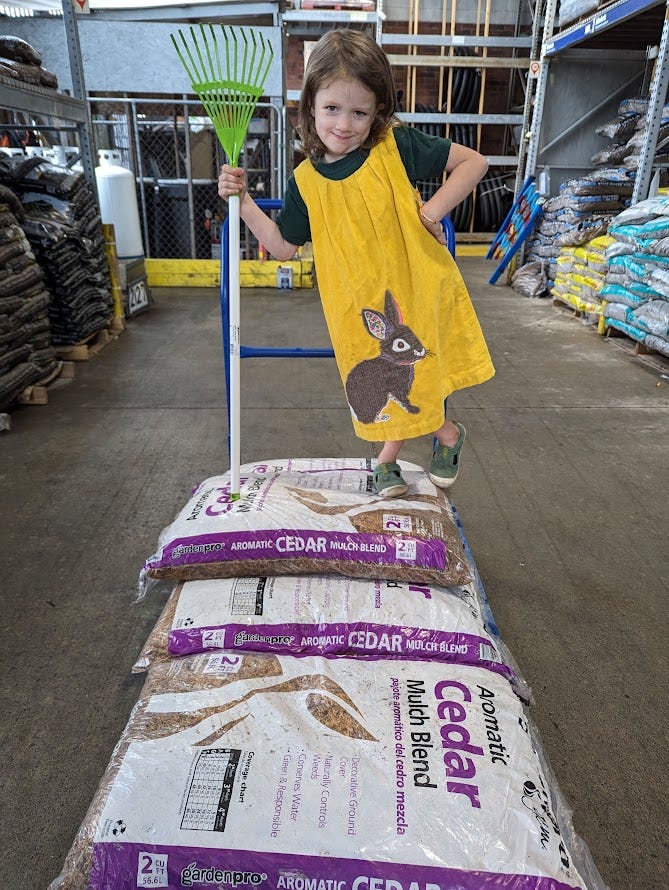
Lucy is proud to be a helper, to learn something new, and to have her own tools.
Enjoy this re-post below, originally titled “How Do I Motivate Kids?” But I’ve since learned that the real takeaway involves lawn mowers and chainsaws.
What do you do when a child won’t do their work?
Saturday is a job day in the Day Household. Everyone has a job description, which helps the kids envision what work to do:
Five-year-old [now six] Lucy is the Zookeeper. She takes care of the cat and stuffed animals.
Seven-year-old [now nine] Robbie is the Gardener.
Nine-year-old [now 11] Calvin’s job is Hospitality and Front-of-House [he has since moved to Apprentice Landscaper]. He [tidied] the front rooms and offered visitors a cold drink.
11-year-old [now 13] Daisy’s job is Communications Officer. She maintains the electronics and cleans the TV room.
And the 40-something-ish folks are Kitchen Worker and Landscaper, respectively. As I said in the last post, the adults should have chores to do at the same time as the kids.
We began the day as we do most Saturdays: with “morning meeting” in which we discuss the plans for the day. We also discuss our mini-economy. Perhaps they want to switch jobs, they think a certain job needs to be done, they wish our home mini-economy store sold so-and-so item, or they want to go on a particular outing. Then we pray, sing the family song (“This is the Day”), and huddle up and cheer “Go Team Day!” (There are a lot of Day family puns, now that I think about it.) Deliberation, goal-setting, family traditions, giving the kids a voice, and work planning set structure and expectations. As I showed in my last post, these are often missing when parents try to get kids to do chores.
Our seven-year-old gardener was not feeling his job last Saturday. Reasons included:
“I have the hardest job”
“I just don’t like pulling weeds”
“I already did it” [editorial comment: inaccurate]
“I have the hardest job”
“I have the hardest job”
In economics, the fundamental lens through which we view the world is “people respond predictably to incentives,” and in fairness, as Gardener, he does have to pull weeds, which might be the worst job. It’s no fun. Hot, time-consuming, strenuous work brings plenty of disincentives with it. (I gave him the option of switching to a different job, which he refused.)
“Great work, Adam Smith,” a sarcastic imaginary parent might say, “you’ve discovered that kids don’t want to work. Thank you, economics.” What incentive does a seven-year-old have for doing his job at all?
Well, Sarcastic Imaginary Parent, people are motivated in two ways: internally and externally. Decades of psychological and economic studies have worried that too many external rewards and punishments can crowd out more wholesome internal motivation. This problem even has a name: Motivation Crowding Theory. I’m thinking about the best way to motivate my children here. We do pay them for their chores, but Motivation Crowding Theory makes me hesitant to emphasize payment too much, or to use withholding payment as a threat.3 This is the day that I tried the route of internal motivation.
“You still didn’t answer the question,” jeers Sarcastic Imaginary Parent, who has now taken up permanent residence in my head, “how are you going to make someone be internally motivated?”
You can’t. If someone doesn’t actually enjoy the task at hand, you only have so much to work with. But you can support people in whatever internal motivation they have, like cupping a flickering match with your hand in a high wind. One way to understand what fosters internal motivation is the “RBG Framework,” which economists have drawn from educational psychology research. Here’s what RBG stands for:
Relevance. People want to know why a task is important.
Belonging. People want to feel like their work supports a community, and the community supports them.
Growth, or a “growth mindset.” When people think they’re immutably good or bad at something, they’re less likely to put effort into working on it. But they will work if they think their work helps them get better. [Note from 2025: and as I argue in Teach a Kid to Save, it’s crucial to give kids jobs that require skill and perhaps which make them learn how to use a tool.]
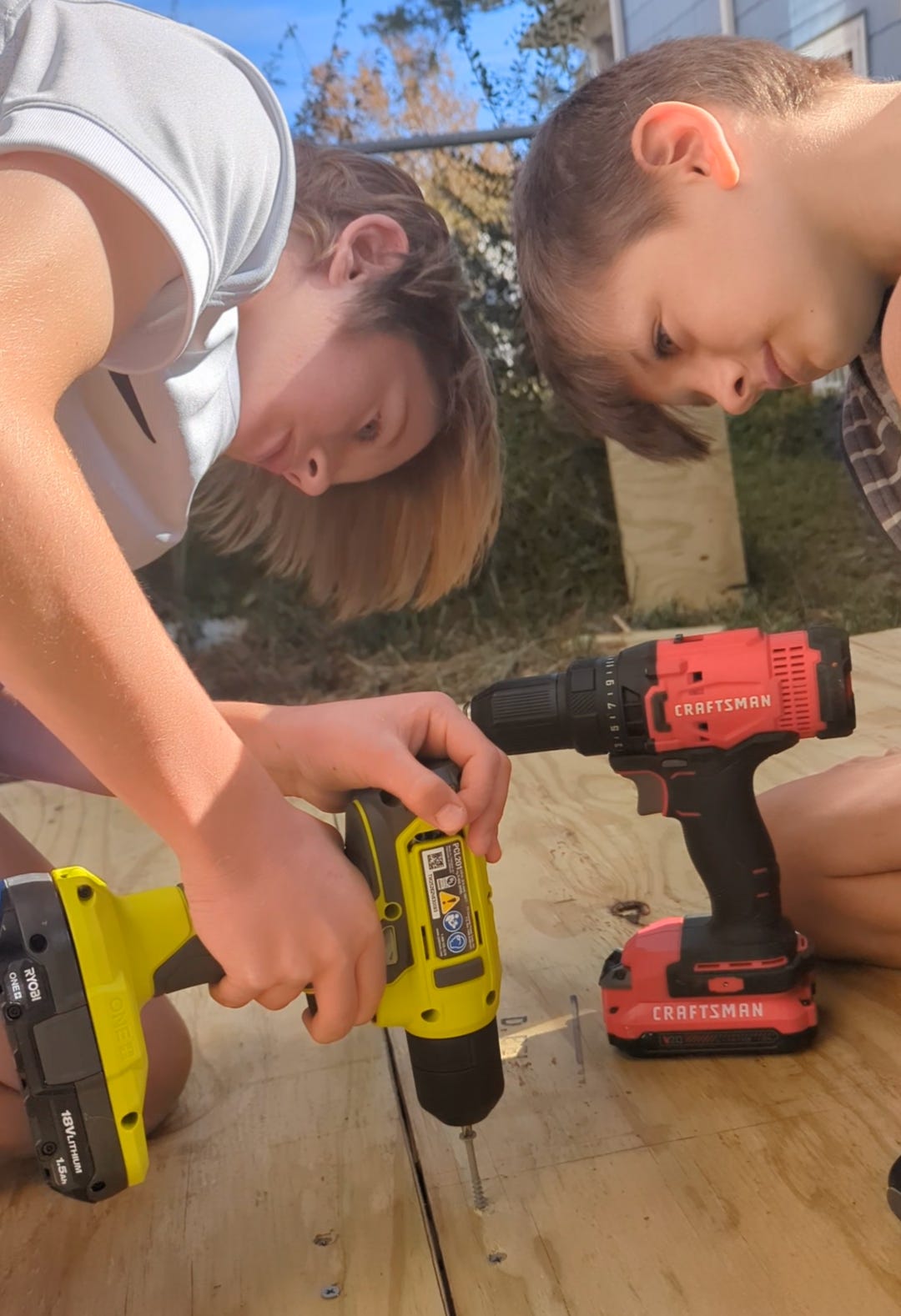
The boys help build a platform for our new shed
I helped Robbie finish his job. While we worked, I tried to reinforce the points above. I reminded him how the job maintains the hard work we did making a flower bed. I told him the family needs him, and he needs the family. And I talked about how all this work makes the house better. Did this talk help? It seemed to help a little. He did his job. I didn’t love this kind of speech when I was a kid. I don’t think a talk like this always works immediately in the moment. Cultivating RBG isn’t an intervention that turns a situation on its head. It’s something you work at over time. It’s a part of creating the structure and expectations that kids need and even crave.
What did work? My wife came outside, and noticing Robbie slumping, asked “Stephen, could he try to mow?” (I had started to mow. I am the Landscaper after all.) He immediately perked up. It was the first time he had been allowed to cut the grass. By the time he was done mowing, he was striding around the yard like he had personally conquered it, and I was digging in the dirt. We had switched jobs, but they got done. Whether this was a parenting victory or not is unclear.
[Now, in 2025, I’ve learned that teaching the kids to safely use power tools is one of the most motivating things you can do.]
How to explain this transformation? If it was due to internal motivation, then you could say he felt like he was growing (the G in RBG). Perhaps mowing made him feel more competent, which is another important aspect of motivation. But there may have been an aspect of external motivation here: mowing felt like a reward. And it was something new. I am quite certain that he won’t be stoked about mowing if he does it every week.
Here’s a good way to think about motivation with kids: you should try to tend to their internal motivation over time, mostly by not snuffing it out. You can do this by using the RBG framework as a tool. Economists and psychologists have long understood that people respond to all kinds of incentives, and those incentives are often not money. But there is a place for external rewards. Sometimes we need rewards or punishments if we’re going to do things that we don’t like. Next week [or the link in the footnotes] we’ll switch our focus from internal motivation to external motivation. We’ll look at when rewards do and don’t help motivate people.
Let me know your experiences in the comments.
How have you built internal motivation for a task? Was it an internal or external incentive?
How have you helped build children’s motivation? (Looking at you, teachers and coaches.)
Kids, what motivates you? What de-motivates you? When is a time that you felt you’ve grown?
What builds relevance? Belonging? A growth mindset?
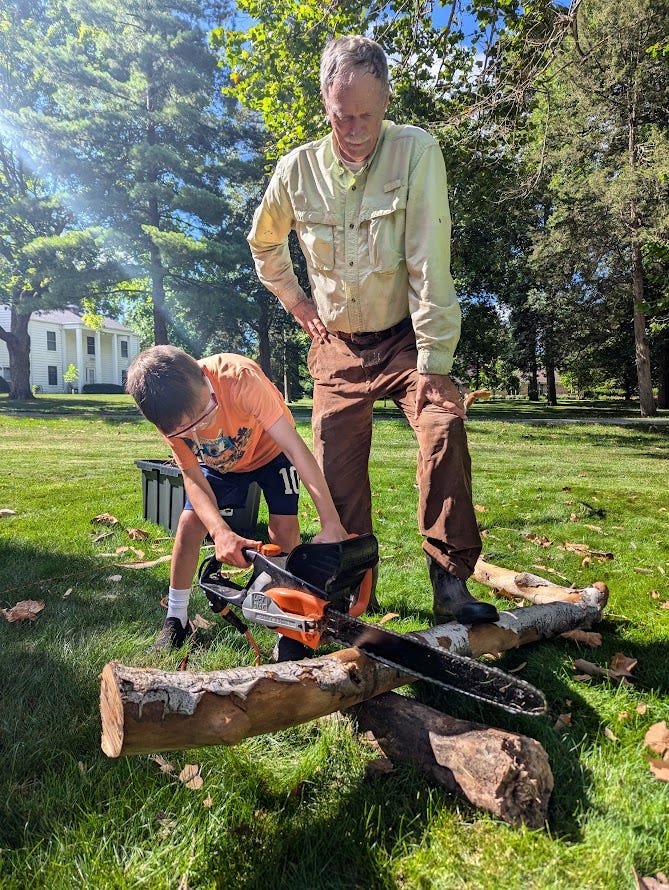
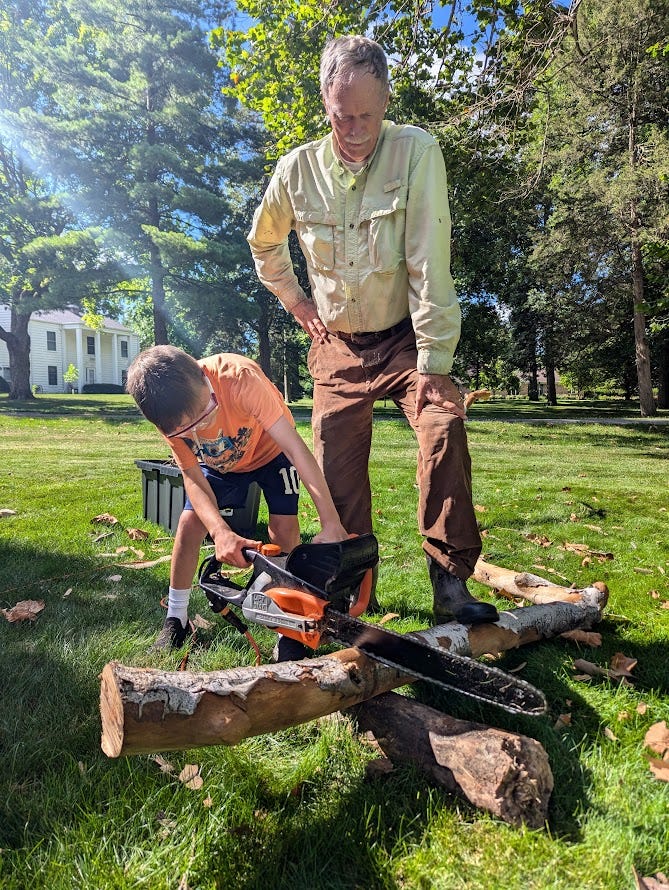
My dad, Harlan, supervises his grandson in learning the chainsaw.
A number of subscribers have indicated that they listen to, rather than read my blog. So many in fact that I think it might be the main way people consume Paper Robots. So I can’t just leave off the audio. But sometimes I’m not in a setting where I can record.
There is some reason from high-quality economics research to suggest that Motivation Crowding Theory is real, but complex. One example is Roland Fryer’s large-scale set of “paying kids to learn” field experiments in urban public schools around 2007–2010. Fryer and his team ran randomized trials in more than 250 low-performing schools in cities like New York City, Chicago, Dallas, and Washington, D.C., involving roughly 38,000 students and about 6.3 million dollars in incentive payments. Students could earn cash for things like test scores, grades, or specific school-related behaviors. Overall, paying for outcomes like higher test scores or better grades produced little improvement in achievement. In contrast, paying for specific inputs, like reading books and other concrete behaviors—generated modest but statistically significant gains in test scores, particularly in reading. Fryer’s take-away that incentives can help when tied to clear, simple actions students understand how to do. See a working paper that you can access here: https://www.nber.org/papers/w15898
That's a great piece! We often discuss that extra credit goes to students who are already doing the work, it's hard to find a good motivator if you cannot tailor it to individuals.
I do listen to the audio, as I miss our chats! lol
And this winter break I have split the organization of closets and toys into smaller tasks, and I am rewarding that with an extra tv show for the kids. It is working well so far.



That's a great piece! We often discuss that extra credit goes to students who are already doing the work, it's hard to find a good motivator if you cannot tailor it to individuals.
I do listen to the audio, as I miss our chats! lol
And this winter break I have split the organization of closets and toys into smaller tasks, and I am rewarding that with an extra tv show for the kids. It is working well so far.
Great piece. It reminds me of the idea mentioned by Hagglund - sometimes we do tasks to generate 'free time' for others in the community/family.
It changed my perception towards chores as well.