
Can We Teach Patience?
This international study says yes (and shows us how)

Researchers in Turkey have uncovered a way to make kids more patient and to help them get in less trouble. The key: classroom teaching.
What did they do, and how did they measure success? Here’s how it worked.
A team of economists, psychologists, and teachers put together a curriculum1 that had one focus: to help kids think about the future when making choices. The team, led by economists Sule Alan and Seda Ertac trained teachers from dozens of schools in how to use the curriculum.2 (Non-paywalled paper here.)
Crucial for measuring the impact of this program was the way they rolled it out. The rollout was done in three phases. This way they could make sure that the effects they observed were causal, not mere correlation. It also allowed them to see the effects of the program over time.
Here’s how the researchers describe what they taught:

“The core material involves eight mini case studies and supporting class activities, with topics that include imagining the future self (forward-looking behavior), self-control against temptation goods, smart shopping, games to make future utilities vivid and close by, saving for a target, viewing and evaluating alternative future outcomes, and developing coping mechanisms against temptation to meet a savings target.”
In one example,
“Children cover a case study titled ‘Zeynep’s Time Machine,’ telling the story of Zeynep, a girl who wants a bike for which she has to save but is also faced with alluring short-term consumption possibilities. The time machine allows Zeynep to travel to two alternative future states (having saved for the bike or not) and observe the consequences of her decisions. Students discuss how Zeynep would feel in each scenario and are asked to imagine themselves in similar situations. Case studies are complemented by class activities and games. … Zeynep’s story involves children actually building a time machine and pretending to travel to future dates of their choice … (e.g., end of the semester, when they get their report cards), as well as drawing related pictures.”

What was your reaction to those activities? I hope it was “wait, that’s not that different. We already do activities like that3 right here in the good ol’ USA! (Or in whichever good ol’ country you are reading this.)
And that’s right. We do use lessons like this in our classrooms. So what makes this study special? A few things:
It rare that researchers go to this much trouble to evaluate the program impact. Making a causal study design is tough to do. This one took resources, and a lot of buy-in from teachers and school divisions, and a very large sample size.
The program was sustained and laser-focused on creating one particular outcome.
Teachers implemented these activities using a Turkish invention called “spare class time.” The time had been set aside by the school systems for enrichment activities. I hope that we can import this invention someday.
How did the researchers measure delayed gratification? They used a well-tested tool that is often used to measure patience in behavioral economics. It’s called the Multiple Price List (MPL) task. In it, students are asked to choose between gifts now or gifts later. (The “gifts” were little trinkets and toys. The students were really given the gifts, though not exactly according to their choice; random students’ choices were picked to divide up gifts amongst the whole class.)4
Here’s what the MPL looks like. Think the famous “Marshmallow Test,”5 but with different steps for more nuanced measurement.
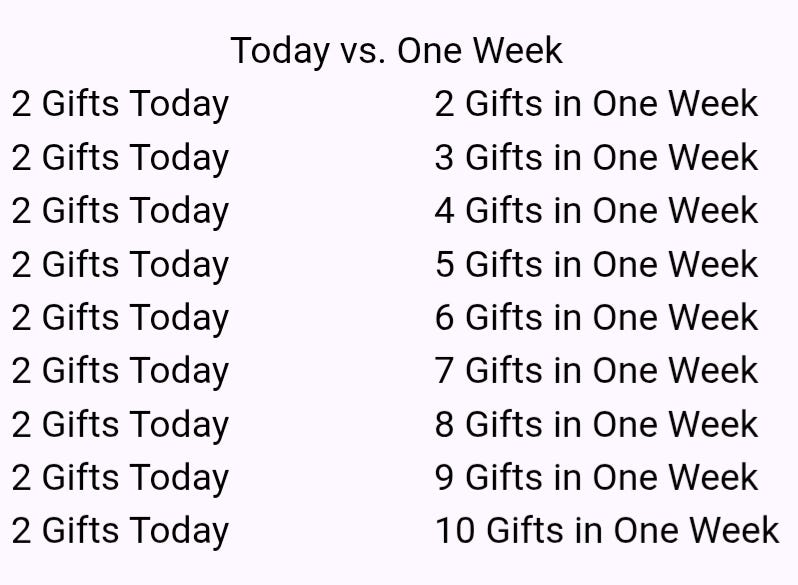
As the researcher put it, a child who has been taught with their program “is expected to more easily and more vividly imagine or remember to think carefully about how he or she would feel as a result of a certain action in the future.”
Well, what was the outcome?
It worked. Students who got the practice in delaying gratification were willing to wait longer to get more real-life gifts. They even improved their classroom behavior grades. And lastly, the researchers followed up with the students into middle school, and found that the effects of delayed gratification persisted.6
What are some takeaways for parents and classroom teachers?
When teaching, connect head knowledge to regular practice. This is how you form habits.
Find a few goals to teach toward over time. Emphasis on few.
Economics and personal finance education has real, enduring effects if done well.
Professional development matters.
Good teaching matters.
If you are already doing these things, you’re probably having the impact that this study describes. You just might not see it yet.
Check for the link to the paper and description of their curriculum in the footnotes. They might be paywalled, so if you can’t get them, just email me and I’ll email them to you.
You are doing great. Keep up the good work!
I offer a Savings Template as a free download at my website, here. It’s a perfect tool for teaching delayed gratification, since it makes the kids draw not only their goal, but also their opportunity cost and the work they must do. Check it out!
This newsletter is supported by the Virginia Council on Economic Education.

The curriculum is summarized here, though it’s paywalled. I’ll see if I can track it down and share it with y’all, ok?
Alan, S., & Ertac, S. (2018). Fostering patience in the classroom: Results from a randomized educational intervention. Journal of Political Economy, 126(5), 1865-1911.
Go to the VCEE Economic Educator Awards page, then scroll down to see all the great lesson Virginia’s teachers have made.
This study also included the Convex Time Budget task, though I didn’t discuss that here.
The Marshmallow Test famously showed that 4-year-olds who resist eating a marshmallow for 10 minutes grow up to have better life outcomes, according to various measures. There has been controversy about the test, mainly because it has been shown that other factors (e.g. family income) explain delayed gratification. Here’s a short article summarizing the debate.
For some of the effect sizes, the paper reports that “in the treatment group, children demand on average 0.82 less gifts to wait for a week from today, and 0.83 less gifts to wait for a week from next week. These estimates correspond to a 0.29 standard deviation effect for the former and a 0.27 standard deviation effect for the latter,” and “We see that impatient behavior in the experimental task has a strong causal effect on the [behavior] grades. Specifically, one extra token allocated to the earlier date leads to 14 percentage point increase in the likelihood of receiving a bad behavior grade.” Unfortunately the researchers could find no persistent effect on behavior in middle school. The most persistent effects on patience were among girls and academically successful students.
I love teaching about the marshmallow test when I teach labor economics, so this was extra cool to read about. Thanks for summarizing the work!